

Preventing Futile Call-Outs: How Letting Agents Can Eliminate Misdiagnosed Property Repairs
For a busy letting agency, property maintenance is a delicate balancing act. On one side, you have the pressure of strict compliance timelines under rental regulations; on the other, you have the commercial necessity of protecting your landlords’ rental yields.
Yet, one of the most persistent drains on both agency time and landlord profitability is the futile contractor call-out – the “no-fault-found” invoice.
Whether it is a contractor dispatched to a “broken” boiler that simply needed its pressure topped up, or an appliance issue caused by a tripped fuse switch, misdiagnosed repairs carry a heavy financial and operational toll. When an agency handles hundreds or thousands of properties, these unnecessary visits quickly erode landlord trust, strain contractor relationships, and burn out your property management team.
To scale efficiently, modern letting agents must move away from reactive dispatching and transition to an automated maintenance workflow.

The Hidden Economics of the “No-Fault-Found” Invoice
When a tenant reports a maintenance issue via email or a basic web form, a property manager (PM) is immediately placed in a high-pressure triage situation. Without granular detail, the standard response is often to dispatch a qualified contractor immediately to ensure compliance and tenant satisfaction.
However, when that contractor arrives to find the issue is purely user error, the financial consequences are severe:
- Aborted Call-Out Fees: Most premium contractors charge a standard call-out rate regardless of whether a physical repair took place.
- The Landlord Dispute: Landlords understandably object to paying for repairs that weren’t actually broken. The letting agent is left caught in the middle, trying to justify an unnecessary invoice.
- Wasted Operational Capacity: Your property managers waste hours logging the job, scheduling the visit, chasing the contractor, and subsequently managing the fallout of the dispute.
Legacy Triage vs. Modern Digital Pre-Diagnostics
To understand how futile call-outs happen, and how to stop them, it helps to look at how traditional workflows stack up against a modern digital ecosystem:
| Maintenance Stage | The Legacy Approach (High Risk of Futile Call-Outs) | The Modern Fiixit Approach (Automated & Protected) |
|---|---|---|
| 1. Issue Reporting | Tenant sends a vague email or leaves a voicemail (e.g., “The heating is broken”). | Tenant uses a guided portal that provides simple menus to capture critical information dependent on the issue category. |
| 2. Initial Troubleshooting | PM must call or email the tenant back to ask for details, often playing phone tag for days. | The PM and tenant can (if required) use chat features to have an active, documented and evidenced dialogue to agree an approach. |
| 3. Issue Verification | PM relies entirely on the tenant’s verbal description, guessing what parts or trade is required. | Mandatory photo/video uploads allow the PM and contractor to visually inspect the fault code or asset damage. |
| 4. Contractor Dispatch | Contractor is sent blind, often resulting in a costly diagnostic visit followed by a second repair visit. | Contractor views the digital triage data, pre-orders exact parts, uses chat features to communicate with PM and tenants and executes a first-time fix. |
| 5. Commercial Outcome | High risk of a “no-fault-found” invoice, a frustrated landlord, and a stressed PM. | Erroneous issues are stopped at the source; landlords pay only for legitimate, verified repairs. |
4 Steps to Eradicate Misdiagnosed Repairs at Scale
1. Implement Digital Pre-Diagnostics at the Point of Reporting
Expecting property managers to act as technical mechanics over the phone is unrealistic and inefficient. Instead, agencies must rely on software that guides tenants to report the repair accurately through a dynamic, conditional reporting process.
If a tenant attempts to report a heating failure, a discussion can be had between property managers, trades and tenants:
- “Have you checked that the boiler pressure is between 1 and 1.5 bar?”
- “Is the prepayment meter topped up with credit?”
- “Have you checked the property’s consumer unit for a tripped fuse?”
By embedding these micro-checks directly into the tenant workflow, a significant portion of user-error issues are resolved quickly, preventing a trade ever being needed to pay a physical visit.

2. Mandate Visual Evidence for High-Error Categories
Text descriptions of maintenance issues are notoriously unreliable. A “leaking washing machine” could be a catastrophic pipe burst, or it could simply be an overloaded drum door.
To eliminate guesswork, agencies should make visual evidence a mandatory prerequisite for specific high-error categories (such as appliances, heating, and damp/mold). Requiring tenants to upload clear photos or a 10-second video clip provides immediate context.
Your property management team can then visually verify the fault code or exact mechanical state of the asset before deciding whether to deploy a professional trade.
3. Streamline Contractor Triage to Ensure “First-Time Fixes”
When a genuine repair is required, sending a contractor to the property completely blind is a recipe for a two-stage visit: one visit to diagnose, and a second to actually fit the parts. This doubles the disruption for the tenant and often doubles the cost for the landlord.
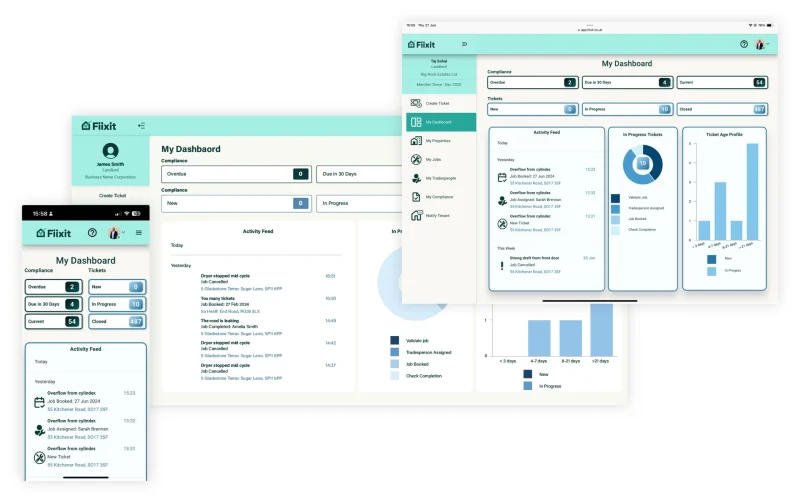
By utilising a centralized maintenance platform, the photos, video clips, and model numbers captured during the tenant’s initial report are passed directly to the contractor’s mobile dashboard. Armed with this data, tradespeople can pre-diagnose the issue from their workshop, order the correct parts in advance, and arrive fully equipped to execute a first-time fix.
4. Protect Your Contractor Network from Admin Fatigue
Good tradespeople are in high demand and short supply. They prefer to work with tech-forward letting agents who value their time and do not waste their schedules on aborted visits.
By filtering out the white noise of phantom repairs, you ensure that when you call a contractor, there is a legitimate, profitable job waiting for them. This drastically improves your agency’s response times, builds loyalty with premium local trades, and ensures your urgent compliance issues are always prioritised.
From Reactive Firefighting to Strategic Portfolio Management
In the modern property management landscape, efficiency is the ultimate competitive advantage. High-street agencies can no longer afford to let manual, unstructured maintenance workflows chip away at their staff capacity and landlord relationships.
By replacing legacy email loops with a structured, digital triage system, letting agents can completely eradicate the friction of unnecessary call-outs. The result is a calmer property management department, happier landlords who see lower maintenance costs, and a highly scalable operation.

Transform Your Maintenance Efficiency with Fiixit
Fiixit is an advanced repair management ecosystem built specifically to help letting agents scale. By combining intelligent and documented tenant communications, mandatory media capturing, and keeping contractors in the loop, Fiixit eliminates human error from the repair process, saving your team time and safeguarding your landlords’ investments.
Ready to protect your agency’s operational margins? Book a demo or sign up for your 3-month free trial today.
- About the Author
- Latest Posts

James Smith
With 25 years of experience in the technology industry, James brings a proven track record in commercial stewardship and transforming financial systems, delivering streamlined and scalable solutions. Now focused on applying this expertise to drive innovation and efficiency in the property sector.
James Smith
- From Compliance to Revenue: How Letting Agents Can Turn the 2026 PRS Database into a Management Win · 21 May 2026
- How Letting Agents Can Automate Property Management And Improve Compliance · 24 March 2026
- Scaling Your HMO and Lettings Portfolio: Moving Beyond WhatsApp & Spreadsheets · 24 February 2026
Contact us
If you're not quite ready to create an account and would like more information about how the Fiixit platform can transform your property repair and compliance process, please reach out to us.

With the development of the Fiixit platform, we’re looking to transform how landlords, tenants and tradespeople work together, removing some of the day-to-day headaches that comes with repairs and compliance management. We believe this will become an important part of the landlord toolkit, supporting them to efficiently manage their property portfolio and fostering positive tenant relationships.
Taj Sohal & James SmithExperienced Landlord and Fiixit Co-Founders.


Sarah Brennan
Trade
Samuel Martin
Trade
Charlotte West
Tenant
Rachel Mulgrew
Tenant
Joe McClellan
Tenant